A Straightforward Guide for Expats, Frequent Travelers, and Remote Workers
The Short Answer: Set up a virtual mailbox before you leave. It gives you a permanent U.S. street address (not a P.O. Box) where your mail is received, scanned the same day, and uploaded to a secure dashboard you can access from anywhere. You decide what to do with each piece: read the scan, forward it internationally, deposit a check into your U.S. bank account, or shred it. USPS mail forwarding only lasts 12 months (60 days for magazines), doesn’t cover FedEx/UPS/DHL shipments, and can’t forward mail internationally in any reliable way.
A virtual mailbox has no expiration, works with every carrier, and keeps you connected to banks, the IRS, and government agencies that require a physical U.S. mailing address.
Key Takeaways
- USPS forwards First-Class Mail for 12 months after a permanent change of address. You can pay to extend it up to 30 months total, but after that, forwarding stops and mail is returned to sender.
- Many U.S. banks, brokerage accounts, and government agencies require a physical U.S. mailing address on file. Some will freeze or close accounts if the only address is international.
- A virtual mailbox gives you a permanent U.S. street address that stays the same no matter how many times you move abroad. You can use it for IRS filings, banking, LLC registration, Social Security, and DMV correspondence.
- You can sign up from outside the U.S. USPS Form 1583 (which authorizes a provider to receive mail on your behalf) can be notarized online via video call.
- Asking a friend or family member to manage your mail works for about a month before the delays, costs, and privacy concerns make it unsustainable.
- Free check deposit, international forwarding with 50 to 80% carrier discounts, and same-day scanning are the features that matter most for expats.
A new beginning
Moving to another country comes with a long checklist, and somewhere between sorting out your visa and figuring out how to ship your belongings, you have to decide what to do about your U.S. mail. Tax notices, bank statements, checks, legal documents, insurance correspondence, government IDs. None of it stops just because you’re no longer at the address it’s being sent to.
Most people assume USPS forwarding will handle it. It won’t, at least not for long. Here’s what actually works, based on 25 years of helping over 100,000 expats, travelers, and remote workers manage their mail from abroad.

USPS Forwarding Is Not a Long-Term Solution
The first instinct most people have is to file a change of address with USPS and forward everything internationally. It sounds simple enough. But there are some real limitations you should know about before you rely on it.
USPS will forward First-Class Mail for 12 months after a permanent change of address. After that, forwarding stops and mail gets returned to the sender. Periodicals like magazines have an even shorter window: just 60 days. Marketing mail and most bulk mail won’t be forwarded at all.
You can buy Extended Mail Forwarding from USPS to add 6, 12, or 18 additional months, but it’s a paid service, it’s non-refundable, and it only covers certain mail types. After that, you’re out of options with USPS.
There’s also an important detail that catches people off guard: USPS change of address only covers mail sent through USPS. It does not affect packages or documents shipped via FedEx, UPS, DHL, or Amazon. Those will continue going to your old address no matter what you file with the post office.
The other common approach is asking a friend or family member to collect your mail and ship it to you. This works for about a month before the delays, the cost of international shipping, and the awkwardness of asking someone to sort through your personal documents starts to wear thin. And if they miss something time-sensitive, you may not find out until it’s too late.
A virtual mailbox solves all of this. Your mail goes to a real U.S. street address (not a P.O. Box), gets scanned the same day it arrives, and shows up on your phone or laptop. You decide what to do with each piece: read the scan, request forwarding, deposit a check, or shred it. No expiration date, no relying on other people, no guessing what’s in the pile.
Keep Your U.S. Address for Banks, the IRS, and Government Agencies
This is where a lot of expats run into real trouble. Many U.S. institutions require a physical U.S. mailing address on file, and some won’t accept a foreign address at all.
Banks and brokerage accounts are often the first problem. Some financial institutions will freeze or close accounts if the only address on file is overseas. The IRS sends notices by mail, not email, and those notices come with response deadlines. The Social Security Administration, DMV, state tax agencies, and courts all communicate by physical mail.
If you don’t have a reliable U.S. address receiving that mail, things can go sideways quickly. A missed IRS notice can turn into penalties. An undelivered court document can result in a default judgment. A bank statement sent to a closed address can trigger a compliance review on your account.
With a virtual mailbox, you maintain a permanent U.S. street address that stays the same regardless of where you physically live. You can use it for:
- IRS correspondence and tax filings
- Bank and brokerage account addresses
- Social Security Administration
- State DMV and vehicle registration
- LLC or corporation registered address (rules vary by state)
- Voter registration (rules vary by state)
- Insurance policies and claims
The key word is permanent. Unlike USPS forwarding, a virtual mailbox address doesn’t expire after 12 months. It stays with you through every move, every country, every apartment change. That kind of stability is worth a lot when you’re living internationally.
You Need Forwarding Flexibility, Not Just One Destination
Here’s something that doesn’t get talked about enough: most people who move overseas don’t stay in one place. You might spend six months in Portugal, then move to Thailand, then come back to the U.S. for the holidays. Or you might have a spouse in one country and a business partner in another who both need access to different pieces of mail.
Many virtual mailbox providers only let you forward to a single address. That’s a problem if your life is actually mobile.
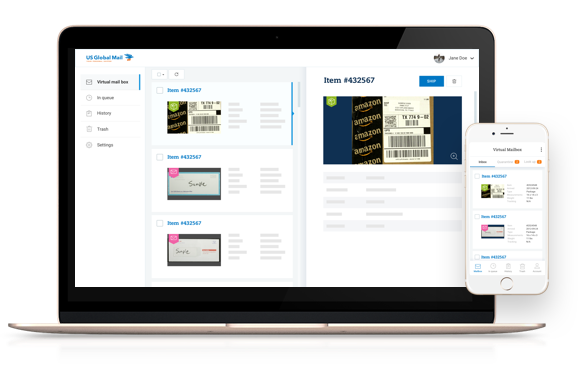
With US Global Mail, you can set up multiple forwarding addresses, both domestic and international, and change them anytime from your dashboard. You can forward a letter to yourself in Lisbon and a package to your accountant in Texas in the same session. If you move again, you just update the destination. No phone calls, no forms, no waiting.
You can also consolidate multiple items into a single shipment to save on international shipping costs. If you’re receiving a few letters and a small package over the course of a week, bundling them into one forwarded shipment can cut your costs significantly. US Global Mail offers 50 to 80% discounts on shipping rates, which adds up fast when you’re shipping internationally on a regular basis.
Managing Your Mail, Not Just Receiving It
There’s a meaningful difference between a service that forwards your mail and a service that lets you manage it. When you’re overseas, management is what matters, because not every piece of mail deserves the same treatment.
Here’s how it works with a virtual mailbox:
- Exterior scans on arrival: Every piece of mail that arrives gets photographed on the outside. You see the sender, the postmark, and the size of the envelope immediately, so you can decide what to do before anything gets opened.
- Interior scanning on demand: For the items you need to read, you request a content scan. The document is opened, scanned in full color, and the encrypted images are uploaded to your account, usually the same day. This is especially valuable for tax documents, legal notices, or anything with a deadline.
- Check deposits: If you receive a check, you don’t need to forward it to yourself and then find a U.S. bank branch (that you’re nowhere near). US Global Mail can deposit checks directly into your U.S. bank account. This is free with every plan.
- Shredding junk mail: Junk mail gets pre-sorted so it never clutters your inbox. Anything you don’t want gets securely shredded and recycled. You don’t pay to forward catalogs and credit card offers you’ll never read.
- Storage: Letters are stored free for 60 days and packages for 30 days. That gives you time to decide what to forward, scan, or discard without feeling rushed.
The goal is that you spend a few minutes a week on your mail, not a few hours. You check your dashboard, scan what’s important, forward what you need physically, shred the rest, and move on with your day.
Switching From Another Mail Service Without Losing Anything
If you’re already using another virtual mailbox or mail forwarding service and thinking about switching, the transition matters more than most people realize. Mail doesn’t bounce back neatly if you close an account too early. It just disappears.
Here’s the safe way to handle it:
- Keep both services running for 30 to 60 days. Don’t cancel your old mailbox the day you open a new one. There will be mail in transit, auto-generated statements with old addresses, and senders who take time to update their records.
- Update your address with every sender that matters. Banks, the IRS, insurance companies, subscription services, business contacts. Make a list and work through it. This is the most tedious part, but it’s also the most important.
- Ask your old provider to forward remaining mail. Most providers will forward any mail that arrives after you’ve officially moved your address. Get this set up before you cancel.
- File a USPS change of address from your old virtual address to your new one. This catches any stragglers that senders haven’t updated yet.
It’s an extra 30 minutes of setup that can save you weeks of headaches down the road.
You Don’t Need to Be in the U.S. to Get Started
One of the most common questions from expats is: “I’m already overseas. Is it too late to set this up?”
No. You can sign up for a virtual mailbox from anywhere in the world. The one step that requires a small amount of effort is completing USPS Form 1583, which authorizes the virtual mailbox provider to receive mail on your behalf. This form needs to be notarized, but in 2026 most providers (including US Global Mail) support online notarization via video call. You don’t need to visit a U.S. consulate or fly back to the states.
Once your account is active, you redirect your mail by either filing a USPS change of address (if you still have a U.S. address on file) or by updating your address directly with each sender. From that point forward, everything goes to your new virtual mailbox and you manage it from wherever you happen to be.
What to Look for in a Virtual Mailbox if You’re Living Abroad
Not every virtual mailbox service is built for international users. If you’re living overseas, here are the specific things that matter most:
- A real U.S. street address: Not a P.O. Box. Many banks, government agencies, and business registrations won’t accept a P.O. Box. Make sure the address is a real physical location.
- Same-day processing: When a tax notice or legal document arrives, you need to know about it that day, not three days later. Ask about processing times before you sign up.
- International forwarding with reasonable rates: Some providers charge retail shipping rates. Look for one with carrier discounts. The difference between paying $45 to forward a letter internationally and paying $15 is real money over the course of a year.
- Check deposit service: Receiving a check when you’re 8,000 miles from your bank is useless without this. Make sure it’s included, not an expensive add-on.
- Security certifications: Your virtual mailbox is handling your tax returns, bank statements, and legal documents. SOC 2 and HIPAA compliance are the standard for serious providers. If a service doesn’t mention either, that’s a red flag.
- Responsive customer support in your time zone (or close to it): When you’re 10 hours ahead and you need a document scanned urgently, email-only support with a 24-hour response time doesn’t cut it. Look for phone and chat options with reasonable hours.
The Bottom Line
Moving overseas doesn’t mean your U.S. mail stops being important. If anything, the stakes go up because the consequences of missing something are harder to fix from abroad. A missed IRS deadline is annoying when you live in Ohio. It’s a genuine problem when you’re in Barcelona and can’t walk into a post office or your accountant’s office.
USPS forwarding was designed as a temporary bridge for domestic moves, not a long-term solution for international living. Asking friends and family to manage your mail is a favor that wears thin quickly. And ignoring it entirely is how people end up with penalties, frozen accounts, and legal headaches.
A virtual mailbox gives you a permanent, stable U.S. address with full control over every piece of mail that arrives. You see it the day it comes in, you decide what happens to it, and you never have to wonder what’s sitting in a pile somewhere.
That’s what US Global Mail has been doing since 1999 for over 100,000 customers, including Fortune 500 companies managing expat mail programs. If you’re planning a move or already living abroad, start with a free trial and see how it works. You’ll wonder why you didn’t set it up sooner.